


Mi hijo menor causó un accidente de auto por DUI en Georgia — ¿Qué hago ahora?
28 August, 2026
Redes Sociales Como Prueba en Casos Criminales en Georgia: Lo Que Publicas Puede Usarse en Tu Contra
3 September, 2026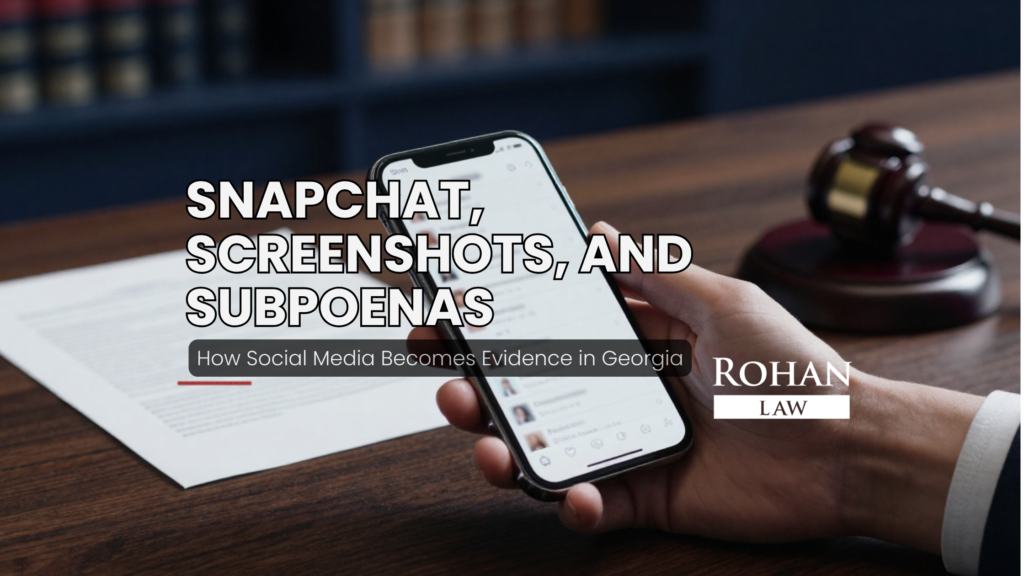
Social Media Evidence in Criminal Case Georgia: Snapchat, Screenshots, and Subpoenas
Most people do not think twice before posting a photo, sending a message, or sharing a story on social media. But in Georgia, social media evidence in criminal cases georgia has become one of the most powerful tools prosecutors use to build a case against someone — and one of the most misunderstood risks defendants face. Whether it is a Snapchat screenshot, a Facebook check-in, an Instagram Reel, or a private direct message, anything you share online has the potential to appear in front of a judge or jury. If you or someone you love is facing criminal charges in Georgia, understanding how digital content is gathered, preserved, and used in court is not optional — it is essential.
Why Social Media Has Become a Goldmine for Prosecutors
People share far more online than they realize. A post meant for friends can be seen by law enforcement. A comment made in frustration can be interpreted as a threat. A photo that seemed harmless can place someone at a specific location at a specific time — directly contradicting an alibi. Prosecutors across Georgia have grown increasingly skilled at mining social media platforms for this kind of information, and courts have consistently upheld the use of this evidence when it is obtained legally. The digital footprint you leave behind is remarkably detailed, and in the context of a criminal investigation, that detail works against you.
What Types of Social Media Content Can Be Used as Evidence in Georgia?
Under Georgia law, nearly any form of digital communication or publicly shared content can be introduced as evidence in a criminal proceeding, provided it meets authentication and relevance standards. This includes public posts, stories, and photos on platforms like Facebook, Instagram, TikTok, and X (formerly Twitter). It also extends to private direct messages, group chats, and even content that has been deleted. Snapchat, despite its reputation for disappearing content, is not immune — screenshots taken by other users, data preserved through third-party tools, or records obtained directly from Snap Inc. via subpoena can all surface in court. Metadata embedded in photos — including GPS coordinates and timestamps — can further corroborate or contradict a defendant’s account of events. For a closer look at how courts are engaging with social media content in real time, watch this informative reel on social media and legal accountability.
How Law Enforcement Obtains Your Social Media Data in Georgia
Law enforcement in Georgia has several legal avenues to access your social media content. For publicly available posts, no warrant is required — officers can simply view and preserve what you have made visible to the public. For private content, investigators can obtain a subpoena or court order directing the platform to release account records, messages, login history, and associated IP addresses. This process is governed by the federal Stored Communications Act as well as Georgia’s own evidentiary standards. Platforms like Meta, Google, and Apple regularly comply with law enforcement requests when presented with the appropriate legal documentation. It is important to understand that deleting a post after an incident occurs does not guarantee that it is gone — it may constitute evidence tampering if done after an investigation has begun, which is itself a serious criminal offense under Georgia law.
Authentication: Can Any Social Media Post Just Walk Into Court?
Not exactly. Before social media evidence is admitted in a Georgia criminal trial, it must be properly authenticated under the Georgia Rules of Evidence. The prosecution must demonstrate that the content is what they claim it to be — meaning they must show it genuinely belongs to the defendant and has not been fabricated or altered. Georgia courts have addressed this issue in several cases, establishing that authentication can be accomplished through profile information, device records, corroborating witness testimony, or metadata. A skilled criminal defense attorney will scrutinize every piece of digital evidence to challenge its authenticity, relevance, and the method by which it was obtained. Improperly obtained digital evidence may be subject to suppression — meaning it cannot be used against you.
Social Media Evidence in Criminal Cases Georgia and Your Constitutional Rights in Georgia Criminal Cases
The use of social media evidence does not exist in a legal vacuum. Your Fourth Amendment rights — which protect you against unreasonable searches and seizures — still apply to the digital world, though their application in this context continues to evolve through case law. If law enforcement accessed your private messages or account data without following proper legal procedures, that evidence may be challengeable. Similarly, your First Amendment right to free expression does not disappear online, and context matters enormously when prosecutors attempt to use speech as evidence of criminal intent. Understanding how these constitutional protections apply to your specific situation is critical, and it is precisely why having experienced legal representation is not a luxury — it is a necessity. If you are navigating a criminal matter in Georgia, our criminal defense practice is here to protect your rights at every stage.
What You Should Do Right Now to Protect Yourself
If you know you are under investigation or have been charged with a crime in Georgia, the single most important step you can take is to stop posting on social media immediately — and to contact a criminal defense attorney before you do anything else. Do not delete posts, messages, or accounts without first consulting your attorney, as doing so could be interpreted as destruction of evidence. Avoid discussing your case online in any form, even in private messages — those conversations are not as protected as you may think. Lock down your privacy settings, but understand that this is not a substitute for legal protection. The decisions you make in the first hours and days after an arrest or investigation can significantly impact the outcome of your case.
Tip from Rohan Law:
“In today’s digital world, your social media profile can be just as incriminating as a fingerprint — and just as powerful when used strategically in your defense.”
Facing Social Media Evidence in a Criminal Case? Contact Rohan Law Today.
At Rohan Law, we understand that being confronted with criminal charges in Georgia — especially when prosecutors are armed with digital evidence — can feel overwhelming and isolating. Attorney Doug Rohan and our dedicated legal team are committed to standing firmly in your corner, scrutinizing every piece of evidence, challenging what does not belong, and building the strongest possible defense on your behalf. We proudly serve clients across Atlanta and throughout Georgia, including our valued Spanish-speaking and bilingual community members who deserve the same quality of representation as anyone else. No matter your background, you have rights — and we are here to protect them. Call or text us 24/7 at (404) 647-0670, email us at info@rohanlawpc.com, or visit us online at www.rohanlawpc.com. Our office is located at 375 Northridge Rd Suite 120, Atlanta, GA 30350.
Related posts