


Menor de Edad con Alcohol en Georgia: Por Qué Su Hijo Puede Perder la Licencia Aunque No Haya Manejado
24 September, 2026
Cargos por Vandalismo en Menores de Edad en Georgia: Cuándo el Grafiti Se Convierte en Delito Grave
29 September, 2026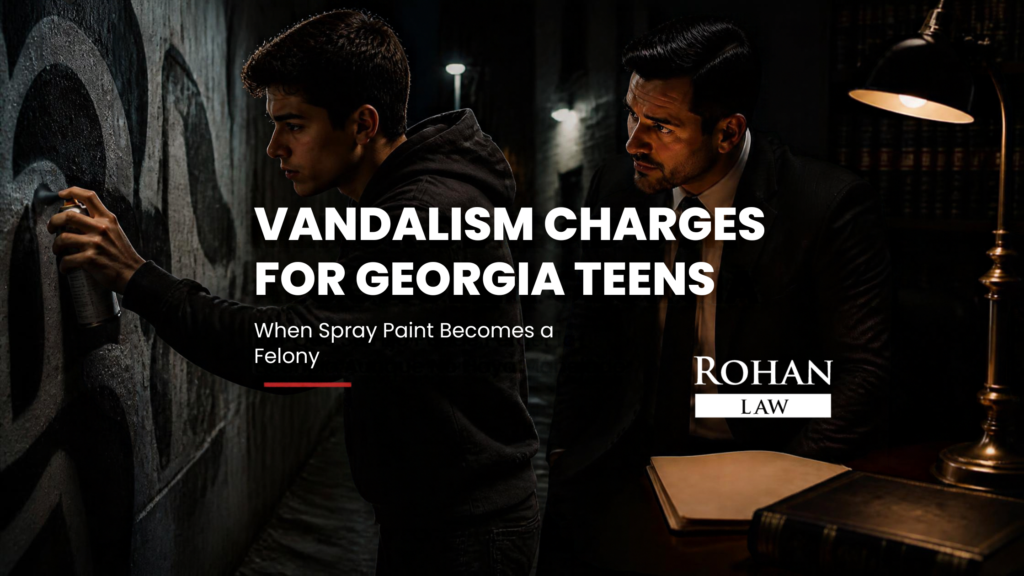
Vandalism Charges for Georgia Teens: When Spray Paint Becomes a Felony
Vandalism charges for Georgia teens are far more serious than most parents realize — and they can escalate quickly. What begins as a moment of poor judgment — a spray-painted wall, a broken window, graffiti on a school building — can transform into a criminal charge that threatens your child’s education, employment opportunities, and long-term future. Under Georgia law, vandalism is not always treated as a minor infraction. Depending on the value of the property damaged, the location of the offense, and the number of prior incidents, your teenager could be facing misdemeanor or felony charges with consequences that follow them well into adulthood. If your family is navigating this situation right now, you are not alone — and the decisions you make in the coming days matter enormously.
What Georgia Law Says About Criminal Damage to Property
In Georgia, vandalism is prosecuted under the criminal damage to property statutes found in O.C.G.A. § 16-7-22 through § 16-7-25. The law distinguishes between first-degree and second-degree criminal damage, and the distinction matters enormously for your teenager’s case. Criminal damage to property in the second degree — which covers intentional damage to the property of another valued at $500 or more — is classified as a felony in Georgia. That means a teenager who spray-paints a school building, a public transit station, or a business facade could be charged with a felony if the cost to repair or replace the damaged surface exceeds that threshold. First-degree criminal damage, which involves endangering human life or causing damage valued over $500 using fire or explosive devices, carries even heavier penalties. Even second-degree charges, however, can result in prison time of one to five years under Georgia sentencing guidelines.
Vandalism Charges for Georgia Teens: How the Juvenile System Works
Georgia operates a separate juvenile justice system designed to handle cases involving minors under the age of 17. In most vandalism cases, a teenager will initially be referred to juvenile court, where the focus is theoretically on rehabilitation rather than punishment. However, do not assume that juvenile court means your child’s case will simply disappear. Juvenile adjudications in Georgia can still result in probation, community service, mandatory counseling, restitution payments to property owners, and detention in a youth development center. More critically, if the vandalism charge is serious enough — or if your teenager has a prior record — the prosecution can seek to have the case transferred to adult criminal court under Georgia’s “transfer” provisions. Once tried as an adult, your child faces the same sentencing exposure as any grown adult, including a felony conviction on their permanent criminal record.
When a Spray Can Becomes a Felony: Understanding the $500 Threshold
Many parents are stunned to learn how quickly repair costs can exceed the $500 felony threshold. Graffiti removal is expensive — commercial sandblasting, repainting, or specialty coatings on brick, concrete, or metal surfaces can easily cost $1,000 or more, even for a relatively small tag. Prosecutors and property owners can present professional damage estimates to support felony charges, and courts are not required to accept a teenager’s claim that “it was just paint.” Additionally, if multiple teens participated in the same vandalism incident, Georgia law can hold each of them jointly responsible for the full cost of the damage — meaning even a minor participant could face the same charges as the person who held the spray can. This principle of joint criminal liability surprises many families and underscores the importance of having experienced legal representation from the very beginning of the process.
The Long-Term Consequences Parents Must Understand
A vandalism conviction — even one handled in juvenile court — can create obstacles that your child will face for years. Felony records can disqualify young people from college financial aid under federal rules. They can prevent enlistment in the military. They can appear on background checks conducted by employers, landlords, and professional licensing boards. Even sealed juvenile records are not always invisible — certain government agencies and licensing bodies retain the right to access them. The emotional toll on your teenager, and on your entire family, can be just as significant. At Rohan Law, we have seen firsthand how a single night of poor decision-making can ripple outward in ways that no family expects. That is why we approach every case with both legal precision and genuine compassion — because we understand what is truly at stake. You can also follow along with real client stories and community updates on our Rohan Law Instagram page, where we share insights that matter to Georgia families every day.
What a Defense Attorney Can Do for Your Teen’s Case
Retaining an experienced criminal defense attorney as early as possible gives your teenager the best chance at a favorable outcome. A skilled defense lawyer can challenge the prosecution’s property damage valuation, negotiate for diversion programs that allow first-time offenders to avoid a permanent conviction, argue against transfer to adult court, and advocate for alternative sentencing such as community service or restorative justice programs. In Georgia, certain first-time juvenile offenders may be eligible for record restriction — commonly known as expungement — once they have satisfied all conditions of their sentence. However, these opportunities do not preserve themselves. They require strategic legal action taken at the right time and in the right way. Our criminal defense practice at Rohan Law is built around protecting the futures of real people, including young people who made a mistake and deserve a second chance.
Advice for Parents: What to Do Right Now
If your teenager has been arrested, cited, or is under investigation for vandalism in Georgia, the steps you take immediately after learning about the situation can significantly affect the outcome. First, do not allow your child to speak with police or investigators without an attorney present — anything they say can and will be used against them. Second, document everything you know about the incident, including the names of any witnesses who may support your child’s account. Third, contact a criminal defense attorney before your teenager’s first court appearance. Public defenders carry heavy caseloads and often have limited time to dedicate to any single case. Private legal representation ensures that your child’s case receives the focused attention it deserves. At Rohan Law, we proudly serve Georgia families in English and Spanish — porque cada familia merece un defensor que hable su idioma y luche por sus derechos.
Tip from Rohan Law:
“The moment your child is contacted by law enforcement is the moment you need an attorney — because in Georgia, a vandalism charge that goes undefended today can become a felony record that closes doors for the next twenty years.”
Facing Vandalism Charges for Your Georgia Teen? Rohan Law Is Ready to Help.
Your child’s future is worth fighting for — and at Rohan Law, fighting for families in their most difficult moments is exactly what we do. Attorney Doug Rohan and our team understand the fear and uncertainty that come with a vandalism charge, and we are here to give you clear answers, honest guidance, and aggressive legal representation. Whether your teenager is facing misdemeanor graffiti charges or a felony criminal damage case, we will assess every detail of the situation and build the strongest possible defense on their behalf. We serve clients across Atlanta and throughout the state of Georgia, and we are available to speak with you any time — day or night. Call or text us 24/7 at (404) 647-0670, email us at info@rohanlawpc.com, or visit us online at www.rohanlawpc.com. Our office is located at 375 Northridge Rd Suite 120, Atlanta, GA 30350. Do not wait — every day without legal representation is a day the other side is building their case.
Related posts