

Compensación Laboral por Daño Psicológico en Georgia: ¿El PTSD y la Ansiedad Califican?
7 July, 2026
Workers’ Comp Settlement in Sandy Springs: Should You Accept the Check or Go to Court?
14 July, 2026Compensación Laboral por Daño Psicológico en Georgia: ¿El PTSD y la Ansiedad Califican?
7 July, 2026Workers’ Comp Settlement in Sandy Springs: Should You Accept the Check or Go to Court?
14 July, 2026Compensación Laboral por Daño Psicológico en Georgia: ¿El PTSD y la Ansiedad Califican?
7 July, 2026Workers’ Comp Settlement in Sandy Springs: Should You Accept the Check or Go to Court?
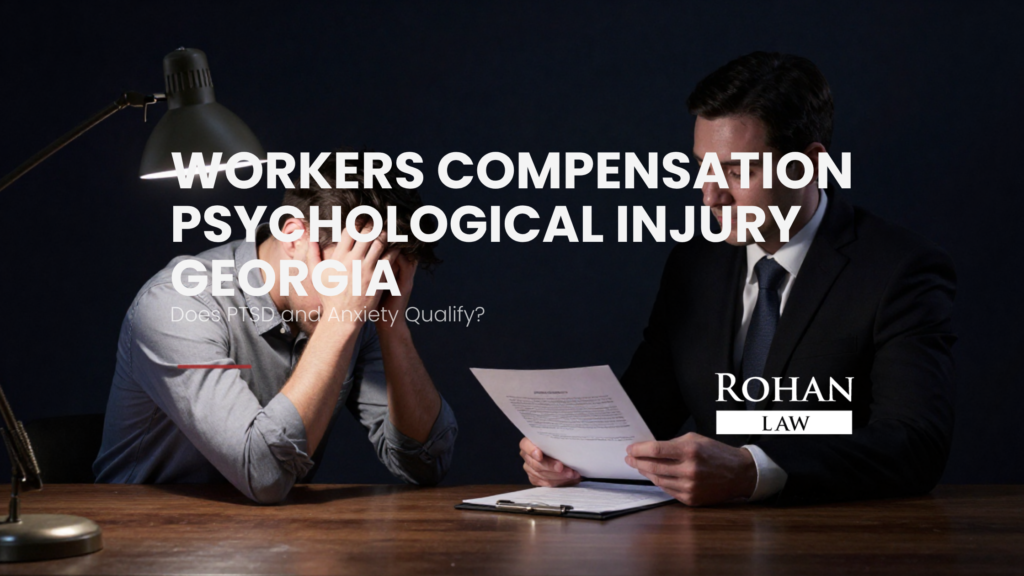
14 July, 2026Not every workplace injury leaves visible scars. For many employees, the hardest part of recovering after a serious workplace accident is not a broken bone or a surgical procedure. It is the emotional trauma that follows. Anxiety, post-traumatic stress disorder (PTSD), depression, and other psychological conditions can make returning to work just as difficult as a physical injury. Unfortunately, many workers never seek benefits because they assume emotional injuries are not covered under Georgia workers’ compensation law. At Rohan Law, we help injured workers understand when psychological injuries may qualify for compensation and what evidence is needed to protect their claims.
Yes, but only under specific circumstances. Georgia workers’ compensation law recognizes certain psychological injuries when they are directly connected to a work-related physical injury. Unlike some other states, emotional stress alone is generally not enough to qualify for benefits. Instead, the psychological condition must arise because of a compensable workplace accident that caused physical harm. This legal distinction makes psychological injury claims more complex than traditional workers’ compensation cases.
Psychological injuries can take many forms. Employees may develop post-traumatic stress disorder after witnessing or surviving a serious accident. Others experience anxiety, depression, panic attacks, or severe emotional distress that begins after suffering a significant physical injury at work. These conditions are often called “invisible injuries” because they cannot be seen on an X-ray or MRI, yet they can dramatically affect a person’s ability to work, sleep, concentrate, and function normally.
The key question is whether the psychological condition resulted from a physical workplace injury. For example, a construction worker who survives a severe fall and later develops PTSD may have a valid workers’ compensation claim if medical evidence establishes the connection between the accident and the psychological condition. However, work-related stress by itself, without an accompanying physical injury, usually does not qualify under Georgia law.
Insurance companies frequently scrutinize psychological injury claims more closely than physical injury cases. Because emotional conditions cannot always be measured through objective testing, insurers may argue that symptoms existed before the accident, are unrelated to work, or are not severe enough to justify benefits. These disputes often make documentation and medical evidence especially important.
Successful psychological injury claims are built on strong medical documentation. Mental health evaluations, consistent treatment records, physician opinions, and documentation connecting the emotional condition to the workplace accident can all play a critical role. Without sufficient medical evidence, insurance companies may deny benefits even when the worker is genuinely suffering from PTSD or anxiety.
Invisible injuries often affect every part of a person’s daily routine. Workers may struggle to sleep, concentrate, interact with coworkers, or return to the environment where the accident occurred. Some develop panic attacks or emotional distress that prevents them from performing the same job they once handled with ease. Although these limitations may not be visible to others, they can be just as disabling as many physical injuries.
Many injured workers simply do not realize that a psychological condition may qualify for workers’ compensation benefits when it follows a physical workplace injury. Others hesitate because they worry their symptoms will not be believed or fear the stigma associated with seeking mental health treatment. Unfortunately, delaying treatment or failing to report symptoms can make an already difficult claim even harder to prove.
Workers compensation psychological injury Georgia cases often require a strong legal strategy from the very beginning. Psychological injuries such as PTSD and anxiety can be more difficult to prove than physical injuries, making proper medical documentation, consistent treatment, and well-organized evidence essential. Understanding how Georgia law applies to psychological injury claims can significantly improve your chances of receiving workers’ compensation benefits and avoiding an unnecessary claim denial.
Tip from Rohan Law:
“Invisible injuries are often the hardest to prove, but they can be just as serious as physical ones.”
Recognizing psychological symptoms early and taking the appropriate legal and medical steps can help protect both your health and your workers’ compensation claim.
If you are experiencing PTSD, anxiety, or emotional trauma after a workplace accident, do not assume you have to face the situation alone. Understanding your rights early can help preserve valuable benefits while ensuring your condition receives the attention it deserves. At Rohan Law, we help injured workers evaluate psychological injury claims and build strong cases supported by medical evidence and Georgia law.
Contact Rohan Law today for a consultation. Call or text us 24/7 at (404) 620-2478, email us at info@rohanlawpc.com, or visit https://www.rohanlawpc.com. We are ready to help you protect your health, your rights, and your future.
Related posts