


Examen Médico Independiente en Georgia: Qué Hacer Cuando No Confías en el Doctor del Trabajo
21 July, 2026
Leyes de Conducción en Zonas Escolares en Georgia: Lo Que Todo Padre y Conductor Debe Saber Este Regreso a Clases
28 July, 2026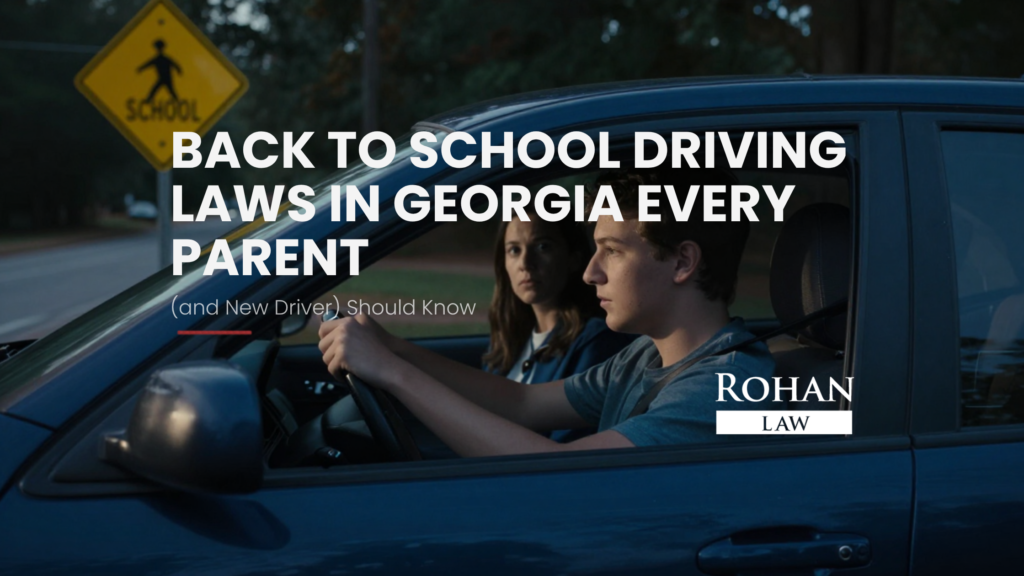
Back to School Driving Laws in Georgia Every Parent (and New Driver) Should Know
Every August, Georgia roads transform almost overnight. School buses reappear on neighborhood streets, crosswalks fill with children, and school zone speed limits go back into effect. Understanding back to school driving laws in Georgia is not simply a matter of avoiding a ticket — it is a matter of protecting lives. Whether you are a parent dropping your child off each morning, a teenager who recently earned their license, or a daily commuter whose route passes a school, the laws covered in this guide apply to you. At Rohan Law, we believe that informed drivers are safer drivers — and that when accidents do happen, you deserve a team that knows exactly how to fight for you.
Georgia School Zone Speed Laws: What the Numbers Actually Mean
Under Georgia law, school zone speed limits are strictly enforced during designated hours — typically when children are arriving at or departing from school. In most Georgia school zones, the speed limit drops to 25 mph, and in some areas it can be even lower. These reduced limits are active when flashing yellow lights are operational or when posted signs indicate restricted hours. Speed cameras are now legally permitted in Georgia school zones under the Act authorizing automated school zone enforcement (O.C.G.A. § 40-14-18), and citations issued by these cameras carry fines starting at $75 for a first offense. Critically, points are not assessed against your license for camera-issued tickets — but a law enforcement officer issuing a citation manually absolutely can add points. Speeding in a school zone is not a minor infraction in Georgia. A conviction can affect your insurance premiums, your driving record, and in serious cases involving injury, it can become the foundation of a personal injury claim against you.
Georgia’s Teenage Driver Restrictions: The Graduated License System
Georgia uses a Graduated Driver Licensing (GDL) system designed to give new drivers real-world experience while limiting their exposure to the highest-risk driving situations. New teen drivers in Georgia progress through three stages: the Class CP Instructional Permit, the Class D Provisional License, and finally the unrestricted Class C License. During the provisional license phase — which most teenagers hold during their first years of school — the restrictions are significant. Teen drivers with a Class D license may not drive between midnight and 5:00 a.m. except for specific exemptions such as driving to or from work or a school-sponsored event. They are also limited to one non-family passenger under the age of 21 for the first six months of holding the provisional license. Violating these restrictions is a misdemeanor under Georgia law and can result in suspension of driving privileges. If your teenager is starting a new school year with a provisional license, sit down together and review these rules before the first school morning.
Georgia’s Hands-Free Law and Why It Matters Near Schools
Georgia’s Hands-Free Law (O.C.G.A. § 40-6-241) prohibits all drivers from holding or using a phone or any stand-alone electronic device while operating a motor vehicle. This means no holding your phone to talk, no reading or sending texts, no scrolling social media — not even at a red light. For drivers under 18, the law is even stricter: no use of a wireless device whatsoever, whether hands-free or not, except in a genuine emergency. Violations carry fines beginning at $50 for a first offense and one point on your license, increasing with subsequent violations. In the context of back to school traffic — where pedestrian volume is at its highest and children can step into the road unpredictably — distracted driving is one of the most dangerous choices a driver can make. A moment of distraction near a school zone can have permanent consequences.
Stopping for School Buses: Georgia Law Leaves No Room for Confusion
Georgia law requires all drivers to stop when a school bus displays its flashing red lights and extends its stop arm — regardless of which direction you are traveling, on roads with two lanes or undivided highways. You must remain stopped until the arm is retracted, the lights stop flashing, and the bus begins to move. The only exception applies to divided highways with a physical median barrier separating opposing lanes of traffic. Failing to stop for a school bus in Georgia is a serious violation carrying a minimum fine of $300 and six points on your license for a first offense. A second offense within five years can result in a fine of up to $1,000. More importantly, children crossing the road near a stopped bus are among the most vulnerable people on Georgia roads. This law exists because lives depend on it.
Back to School Driving Laws in Georgia and DUI: The Stakes Are Higher Than Ever
The start of the school year brings not only morning drop-offs but also Friday night games, late practices, and social events where alcohol and substances may be present. Georgia enforces a zero-tolerance policy for drivers under 21 — any measurable blood alcohol content above 0.02% can result in a DUI charge. For drivers 21 and over, the legal limit is 0.08% BAC, but impairment at any level is dangerous and actionable under Georgia law. A DUI conviction near a school or involving a minor can carry significantly enhanced penalties. If you or someone you love has been charged with DUI, the first hours after an arrest are critical — our team encourages you to read more about what to expect after a DUI arrest in Georgia and to seek experienced legal guidance immediately. You can also review our insights on Georgia traffic violations and your legal rights to better understand how a charge can affect your driving record and future. For a broader look at how the first 24 hours after a Georgia DUI arrest can shape your entire case, read this important overview from Rohan Law on Facebook.
Pedestrian and Crosswalk Rules That Drivers Often Overlook
Georgia law requires drivers to yield the right of way to pedestrians who are in a marked crosswalk or an unmarked crosswalk at an intersection. Near schools, crosswalks are often staffed by crossing guards during arrival and dismissal hours — and a driver who fails to obey a crossing guard’s signal is not only breaking the law but creating a situation that could result in catastrophic injury to a child. Under O.C.G.A. § 40-6-91, drivers must also exercise due care to avoid colliding with any pedestrian at any time. When a child darts into the road — which, given the unpredictability of young pedestrians, does happen — the legal question is whether the driver was exercising due care. If you were driving distracted, speeding, or violating any other statute at the time, that violation can be used to establish negligence in a personal injury claim.
When an Accident Happens Near a School: What Parents and Drivers Need to Know
Despite every precaution, accidents happen. A driver runs a school zone light. A distracted parent rear-ends another vehicle in the carpool line. A teenager on a provisional license causes a collision on the way home from school. When these situations occur, the legal steps you take in the immediate aftermath matter enormously. Call 911, document the scene if it is safe to do so, exchange insurance information, and avoid making any statements that could be interpreted as admitting fault. Georgia’s modified comparative fault rule means that if you are found to be 50% or more at fault for an accident, you may be barred from recovering damages. That is why having an experienced legal advocate on your side — someone who knows Georgia traffic law and knows how to negotiate with insurance companies — is so important. At Rohan Law, we serve both English-speaking and Spanish-speaking clients across Georgia, and our team is available to you 24 hours a day, seven days a week.
Tip from Rohan Law:
“The moment another driver’s negligence puts your family at risk near a school zone, the law is on your side — but only if you act quickly and get the right legal team in your corner.”
Injured in a School Zone Accident? Contact Rohan Law and Know Your Rights Under Georgia Driving Laws
At Rohan Law, founded by attorney Doug Rohan, we are committed to making sure that every Georgian — regardless of background, language, or economic status — has access to the strong, strategic legal representation they deserve. If you or a member of your family has been injured in a car accident near a school, in a school zone, or in any situation involving a negligent driver this back to school season, our team is ready to help you understand your options and fight for the full compensation you are owed. We proudly serve English-speaking and Spanish-speaking clients throughout Georgia, and we are available 24/7 because we know that accidents do not happen on a convenient schedule. Call or text us anytime at (404) 647-0670, email us at info@rohanlawpc.com, or visit us online at www.rohanlawpc.com. Our office is located at 375 Northridge Rd Suite 120, Atlanta, GA 30350. Your first consultation is always free — because getting answers should never cost you anything.
Related posts